
Startup in a Night: How low-code and AI are breaking the development market
Yesterday: to test an idea, you had to assemble a team, write a technical specification, and spend months and a substantial amount of money.
Today: a low-code platform and a neural network are enough to throw together a working prototype in an evening based on the vibe. This is no longer a joke from developer chats—it's how products are actually launched.

"Vibe-coding" sounds like a meme, but it's already a perfectly viable approach. The concept is simple: instead of spending weeks thinking about architecture and drawing diagrams, a developer or product manager opens an AI tool, provides a text description, and within an hour has a basic interface or even a complete application in their hands.
For example, you open Cursor, type in the chat, "I want to create an app for tracking personal expenses," and half an hour later, you have a working prototype. No studying documentation, no architectural planning, no 40-page technical specifications. You simply described the task in plain language and received the code.
It's actually similar to a jam session in music: you gather ideas, play "by ear," and record a track. In IT, this translates into rapid MVPs, where the speed of hypothesis testing is valued more than a perfect architecture.
Previously, building an MVP required a team, months of work, and a budget comparable to a small startup's fund. Now, things look completely different.
- Low-code platforms eliminate routine. Ready-made blocks, visual interfaces, out-of-the-box integrations. According to Gartner, by 2025, 70% of enterprise applications will be created using low-code, compared to 25% in 2020. The market is growing from $26.3 billion (2025) to $67.12 billion by 2030.
- Neural networks provide a powerful boost: GitHub Copilot, for example, speeds up task completion by 55%, and up to 46% of the code in projects is written automatically.
- A new generation of tools like V0 or Claude Artifacts can turn a text description into a ready-made interface or application. Now, it's realistic to build an MVP in just a couple of hours.
In effect, businesses have gained an "idea accelerator": conceive it — build a prototype — show it to the market — gather feedback — refine.
Real-world stories demonstrate better than any forecast that "vibe-coding" is already a reality.
- The French marketplace Comet was built on Bubble. In three years, the startup attracted €14 million in investment and reached $800,000 in monthly revenue.
- Toyota implemented an AI system for predictive maintenance. The result: a 25% reduction in downtime, an ROI of 250-300%, and $10 million in annual savings.
- Barclays accelerated loan approvals threefold: from 10–15 days to 3–4, reduced errors from 20% to 5%, and increased customer satisfaction to 90%.
What do these stories have in common? In each case, there's a focus on speed and tools that allow testing an idea before competitors have a chance to enter the market.
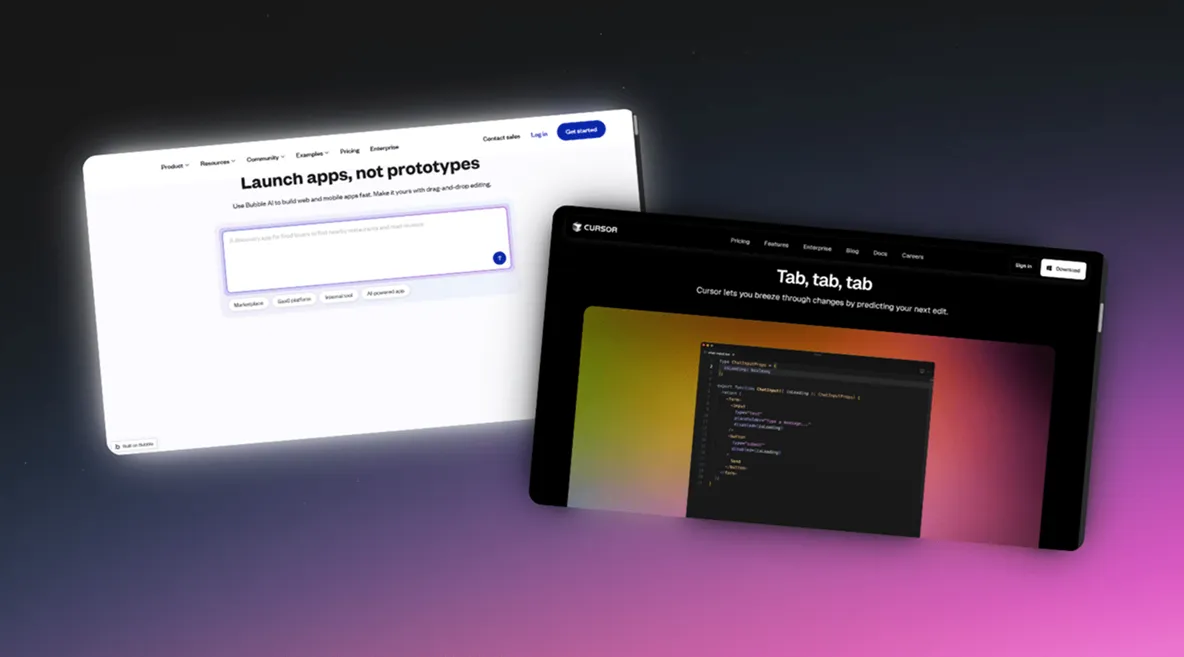
If you're going to vibe-code, here are five tools leading the charge:
- Bubble — a builder for web applications of any complexity. It's used to build everything from marketplaces to fintech.
- GitHub Copilot — an AI assistant that writes up to 46% of your code for you.
- V0 — turns a text description into a ready-made interface in minutes.
- Claude Artifacts — creates full-fledged application prototypes on the first try.
- Directual — a low-code platform for MVPs and complex projects with API and automation.
These five tools are enough to build a prototype in a day and test an idea without needing a whole team.
Here's what it usually looks like in practice:
- Formulate the task in plain language. You don't need a 50-page document. I want an expense tracking app with Google login plus a more or less clear description in natural language is enough.
- Choose the right tool for the job: A web app? Use Bubble or Directual. A landing page? Tilda will work. Need to connect services? Zapier or Make. Want to speed up coding? GitHub Copilot, Cursor, V0, Claude Artifacts.
- Build a draft. Describe the task or click blocks in the builder—you get a working interface without a single line of code.
- Add basic logic. Forms, buttons, a database, authorization. For anything complex, it's better to entrust it to an AI assistant.
- Test it on people. Launch the prototype for colleagues or friends. If the idea doesn't fly, kill it. Quick and cheap.
Important: Vibe-coding isn't about perfect architecture. It's about rapid experimentation. If a hypothesis proves successful, then you bring in a team and write the code "for real."
Pros: results in an evening, cheap experiments, not just developers but also marketers and designers can get involved.
Cons: platform dependency, lack of customization, the risk of being left with a raw MVP that never makes it to production.

- Don't try to make it pretty right away. The goal is to test an idea, not to build a perfect system. Save the aesthetics and architecture for later.
- Limit your time. Set a deadline for yourself: No more than one evening for the prototype. This helps cut out the fluff and focus on the core.
- Write down your hypotheses. Before you dive into Bubble or Directual, note down exactly what you want to test. It will be easier to determine later if it worked or not.
- Gather feedback immediately. Don't wait for a perfect MVP. Show the prototype to colleagues, friends, or a few target users. Mistakes at this stage cost next to nothing.
- Don't fall in love with the prototype. Vibe-coding is about experiments. Sometimes the best strategy is to throw the project away and start over.
- Think about the grown-up stage. If the hypothesis is a success, be prepared for the fact that the code will have to be rewritten and the architecture rebuilt from scratch.
Vibe-coding isn't about laziness or "hacker chaos." It's about not procrastinating and testing ideas immediately. Come up with an idea in the morning—by evening, you're already "feeling out" the prototype. The next day, you show it to friends or early users and figure out if it's worth pursuing or if you should pivot and move on.
Of course, there are downsides: platforms create lock-in, customization is limited, and AI can sometimes be sluggish. But the truth is, the market doesn't wait. And the winner isn't the one who writes the most beautiful code, but the one who tests hypotheses the fastest.