

Breakthrough in Robotics: New Artificial Muscle Is 4,000 Times Stronger Than Human Tissue
Researchers at the Ulsan National Institute of Science and Technology (UNIST) in South Korea have engineered a revolutionary artificial muscle for robots. This new material, a polymer infused with shape-memory magnets, uniquely combines the flexibility and strength of biological muscles, marking a significant leap forward for soft robotics.
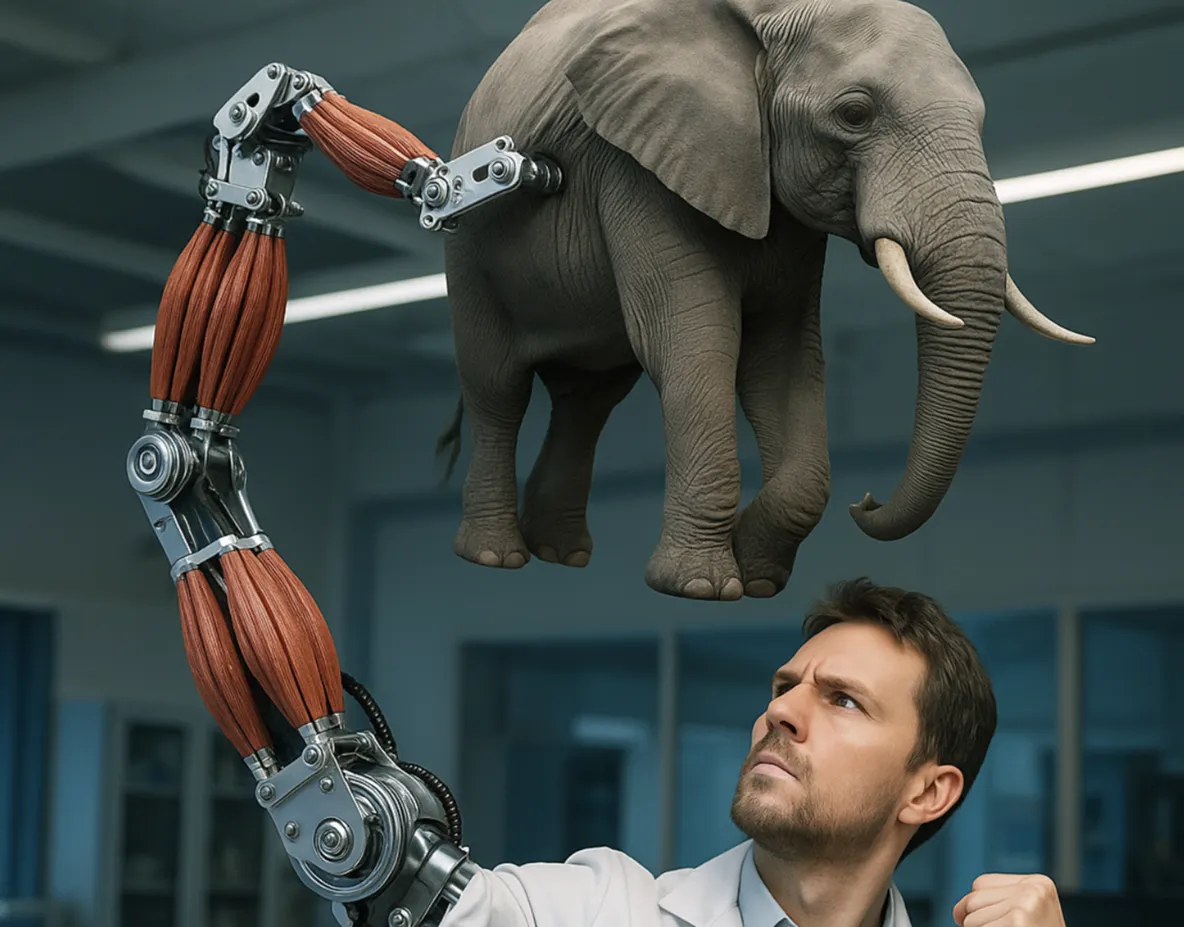
This groundbreaking material can seamlessly switch between soft and rigid states, enabling humanoid robots to lift objects up to 4,000 times their own weight.
Solving the Strength vs. Flexibility Trade-off
Traditional artificial muscles have always faced a critical limitation: a trade-off between strength and flexibility. Materials were either highly deformable with weak force or incredibly strong with minimal movement. This has been a significant hurdle in creating versatile robots.
The UNIST team’s new composite, based on stearyl methacrylate and infused with neodymium-iron-boron (NdFeB) microparticles, shatters this limitation. It uses a combination of thermal and magnetic controls to adjust its stiffness on the fly, creating a material that is both powerful and pliable.
How It Works: A Dual-Control System
- Heating: The material becomes soft and malleable when heated.
- Shaping: While soft, a strong magnetic field aligns the internal magnets to set a desired memory shape.
- Cooling: As it cools, the material becomes incredibly rigid, locking the shape in place.
- Activation: An induced magnetic field can later trigger the muscle to return to its programmed shape, allowing it to be flexible when needed and as hard as steel when required.
Unprecedented Performance
- Stretching: Can elongate over 12 times its original length (1274%) before breaking.
- Contraction: Compresses by 86.4%, double the capability of human muscle.
- Work Capacity: Performs 30 times more work (1150 kJ/m³) than biological tissue.
- Variable Stiffness: Can shift from rubber-like softness (213 kPa) to hard plastic rigidity (292 MPa), a 1000-fold difference.
- Lifting Power: A tiny 1.2-gram strip can support 5 kg when rigid.
Future Applications and Challenges
While still in the early stages, this material holds immense promise for the future of soft robotics. Potential applications include home assistants that are safe for human interaction, powerful exoskeletons, and advanced medical instruments.
However, before this technology can be widely adopted, researchers must address several challenges. The material's slow response to temperature changes needs to be improved for practical use, and a method for generating strong, localized magnetic fields for activation is still required.