

Quarkus Mutiny: A Deep Dive into Asynchronous Superpowers
What Exactly is Mutiny?
At its core, Mutiny is a library that helps you deal with events that will happen... eventually. Instead of writing code that waits around, blocking everything, you write a 'recipe' for what to do when an event occurs. Mutiny provides two fundamental building blocks for this. For a complete guide, the official Mutiny documentation is an excellent resource.
Uni<T>: Represents a result that will arrive in the future. It can emit exactly one item or a failure. Think of it as a superchargedFutureorPromise. Perfect for operations like a single database query, an HTTP request, or any action that yields one result.Multi<T>: Represents a stream of items that will arrive over time. It can emit zero, one, or many items, followed by a completion signal or a failure. This is ideal for things like streaming database results, consuming messages from a Kafka topic, or handling WebSockets.
The beauty of Mutiny lies in its expressive, event-driven API. You don't write complex callback chains. Instead, you write pipelines that read like plain English: onItem().transform(...), onFailure().retry(). It’s a declarative style that makes your asynchronous logic clear and maintainable.
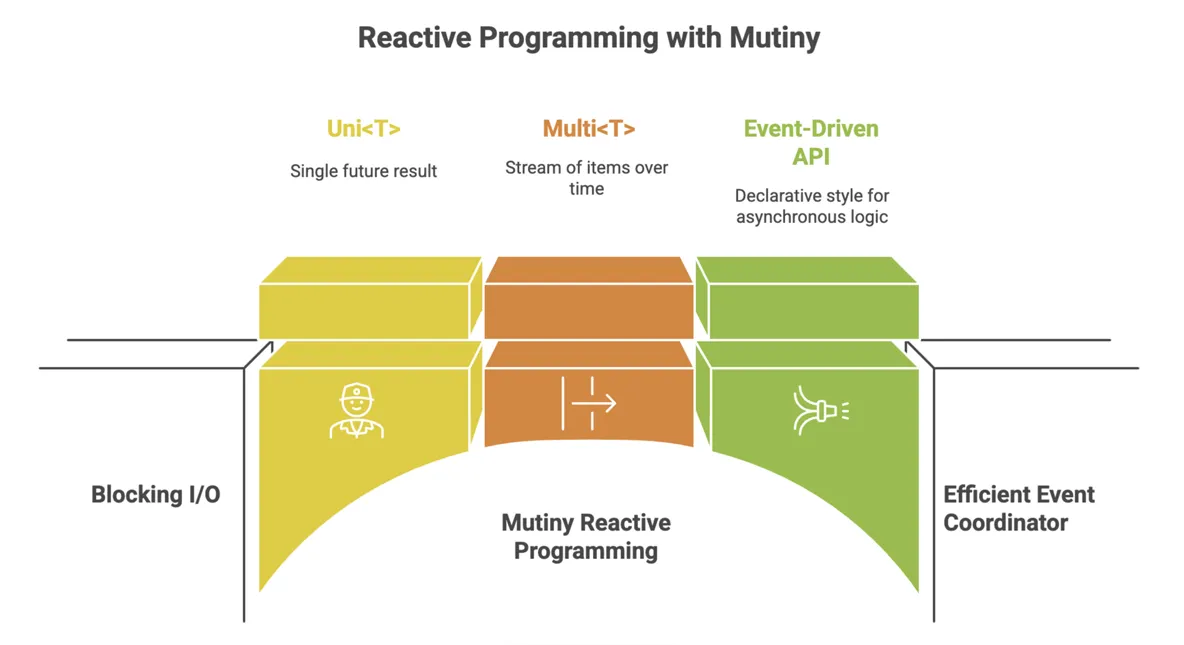
The Great Divide: Normal (Imperative) vs. Reactive Thinking
Before we dive into code, let's tackle the biggest mental hurdle. How is this different from the way we've always written code?
The Old Way: The Blocking Waiter
In traditional, imperative programming, your code is like a waiter who takes one order, goes to the kitchen, and stands there, doing nothing, until the dish is ready. Only after delivering that dish can they take the next order. This is called blocking. The thread of execution is stuck waiting for an I/O operation (like a database call) to complete.
// Traditional Blocking JDBC
public User findUserById(long id) {
    // 1. The thread BLOCKS here, waiting for the database.
    ResultSet rs = connection.executeQuery(SELECT * FROM users WHERE id =  + id);

    // 2. Only after the database responds, this code runs.
    if (rs.next()) {
        return new User(rs.getString(name));
    }
    return null;
}
In a high-traffic application, having many threads blocked and waiting is incredibly inefficient. It's like hiring a hundred waiters who each serve only one table at a time.
The Mutiny Way: The Efficient Event Coordinator
Reactive programming is like an event coordinator with a clipboard. They don't wait for anything. They tell the kitchen, 'Start cooking this dish, and notify me when it's ready.' Then they immediately move on to the next task. When the kitchen buzzes, they pick up the dish and deliver it. This is non-blocking. The thread dispatches the I/O request and is immediately freed up to handle other work. You provide a 'continuation'—the code that should run when the result is ready.
// Reactive with Mutiny
public Uni<User> findUserById(long id) {
    // 1. This method returns IMMEDIATELY with a Uni.
    // The database query is scheduled to run in the background.
    return reactiveCollection.find(eq(_id, id)).first();
}

// Somewhere else, you define what to do with the result.
findUserById(123)
    .onItem().transform(user -> user.name.toUpperCase())
    .subscribe().with(
        name -> System.out.println(User found:  + name),
        failure -> System.err.println(Oops:  + failure.getMessage())
    );
The key takeaway is that with Mutiny, you are not waiting for results. You are composing a pipeline that will react to results when they arrive. This allows a small number of threads (the Quarkus I/O threads) to handle a massive number of concurrent requests.
Mutiny in Action: A Simple Example
Talk is cheap. Let's build a simple service to manage a list of 'Widgets' using Quarkus and the reactive MongoDB client.
public class Widget {
    public ObjectId id;
    public String name;
    public int quantity;

    public Widget() {}

    public Widget(String name, int quantity) {
        this.name = name;
        this.quantity = quantity;
    }
}
@ApplicationScoped
public class WidgetService {
@Inject
ReactiveMongoClient mongoClient;
private ReactiveMongoCollection<Widget> getCollection() {
return mongoClient.getDatabase(widgetsDB).getCollection(widgets, Widget.class);
}
// --- Using Uni for a single result ---
public Uni<String> addWidget(Widget widget) {
return getCollection()
.insertOne(widget) // Returns Uni<InsertOneResult>
.onItem().transform(result -> result.getInsertedId().toString()); // Transform the result to the ID string
}
// --- Using Multi for a stream of results ---
public Multi<Widget> getAllWidgets() {
return getCollection().find(); // Returns a Multi<Widget>
}
}Notice how these service methods don't block. They immediately return a Uni or a Multi. The actual database interaction hasn't even started yet! It's just a plan. To execute the plan, the caller (e.g., a JAX-RS resource) needs to subscribe. Quarkus REST often handles this for you automatically.
@Path(/widgets)
public class WidgetResource {

    @Inject
    WidgetService service;

    @POST
    public Uni<Response> add(Widget widget) {
        return service.addWidget(widget)
                .onItem().transform(id ->
                    Response.created(URI.create(/widgets/ + id)).build()
                );
        // Quarkus REST subscribes to the Uni for you and sends the response.
    }

    @GET
    @Produces(MediaType.SERVER_SENT_EVENTS)
    public Multi<Widget> list() {
        return service.getAllWidgets();
        // Quarkus REST subscribes and streams the results to the client.
    }
}
Top Errors: When Java 8 Streams Thinking Goes Wrong
Many developers coming from a background of Java 8 Streams fall into common traps because the APIs look superficially similar. But they operate on fundamentally different principles. A Stream is eager about its data source (the collection exists now), while a Mutiny pipeline is lazy about its event source (the event will happen later).
Error #1: The Silent Failure (Forgetting to Subscribe)
The Symptom: You write a beautiful Mutiny pipeline, run your code, and... nothing happens. No error, no log message, no database entry. Silence.
A Mutiny pipeline without a subscription is just a blueprint for a machine that is never turned on.
// WRONG: This does absolutely nothing!
public void someMethod() {
    Uni<String> myUni = createSomeAsyncOperation();

    // You've defined the plan, but never told it to execute.
    myUni.onItem().transform(String::toUpperCase);
}
// RIGHT: Subscription triggers the action.
public void someMethod() {
Uni<String> myUni = createSomeAsyncOperation();
myUni
.onItem().transform(String::toUpperCase)
.subscribe().with(result -> System.out.println(result));
}Error #2: The Nested Nightmare (Using `transform` instead of `transformToUni`)
The Symptom: Your pipeline's return type is something weird like Uni<Uni<String>>. You wanted to chain two async operations, but ended up with a nested 'promise'.
This happens when you use .onItem().transform() (which is for synchronous functions, like Java's map) when you should be using .onItem().transformToUni() (which is for asynchronous functions that return another Uni, like Java's flatMap).
// WRONG: This returns a Uni<Uni<User>>
public Uni<Uni<User>> findAndEnrichUser(long id) {
    return findUserById(id) // Returns Uni<UserRecord>
            .onItem().transform(record -> fetchUserDetails(record.getDetailId())); // This returns another Uni!
}
// RIGHT: transformToUni flattens the result into a single Uni<User>
public Uni<User> findAndEnrichUser(long id) {
return findUserById(id) // Returns Uni<UserRecord>
.onItem().transformToUni(record -> fetchUserDetails(record.getDetailId()));
}Error #3: The Cardinal Sin (Blocking an I/O Thread)
The Symptom: Your application freezes under load, or Quarkus throws a big, scary IllegalStateException: The current thread is an I/O thread....
This is the most critical error. In a moment of desperation, you might be tempted to get the value out of a Uni by calling .await().indefinitely() inside your reactive pipeline. Never do this on an I/O thread. You are bringing the entire non-blocking model to a screeching halt. The whole point is to chain operations asynchronously, not to stop and wait.
// WRONG: NEVER DO THIS IN A REACTIVE PIPELINE!
Uni<String> result = someUni
    .onItem().transform(item -> {
        // This blocks the I/O thread, defeating the purpose of reactive!
        String details = getDetailsUni(item).await().indefinitely();
        return item +  with  + details;
    });
// RIGHT: Chain asynchronously with transformToUni
Uni<String> result = someUni
.onItem().transformToUni(item ->
getDetailsUni(item)
.onItem().transform(details -> item + with + details)
);Where to Go From Here
- Learn how Mutiny integrates with Vert.x in this Quarkus blog post.
- Dive deeper into advanced patterns like merging vs. concatenating streams.
- Understand the nuances of threading with the guide on emitOn vs. runSubscriptionOn.
- For bridging the gap from imperative code, check out how to handle explicit blocking operations safely.
Mutiny is a powerful tool that, once you grasp its event-driven nature, can dramatically simplify the way you write complex, asynchronous applications in Quarkus. It encourages a clean separation of concerns and guides you toward building robust, non-blocking systems. So go ahead, embrace the flow, and let your code react to the future.