

Sysadmin, DevOps, and SRE: How to Understand These Roles So They Don't Harm Your Career or Business
There's a persistent myth in the IT community that DevOps and SRE are just the next steps in a System Administrator's career.
System Administrator
Sysadmins are often stereotyped as the people who just fix printers or perform mysterious rituals in a data center. In reality, their role is far more foundational. They build and maintain the core engineering platform that supports everyone else.

Core Responsibilities:
- Installing, configuring, and updating core infrastructure software.
- Supporting and monitoring infrastructure applications.
- Designing and implementing new IT infrastructure components.
Business Value: A skilled sysadmin ensures the optimal use of computing resources, saving money and reducing security risks by maintaining an up-to-date infrastructure stack.
Key Metrics:
- SLA (Service Level Agreement): A commitment to the level of service.
- SLO (Service Level Objective): Specific, measurable targets for the SLA.
- SLI (Service Level Indicator): The actual measurement of service performance.
DevOps Engineer
Technically, DevOps is a methodology, and a DevOps Engineer is the person who implements it. Their primary responsibility is the automation of the entire development and delivery pipeline.
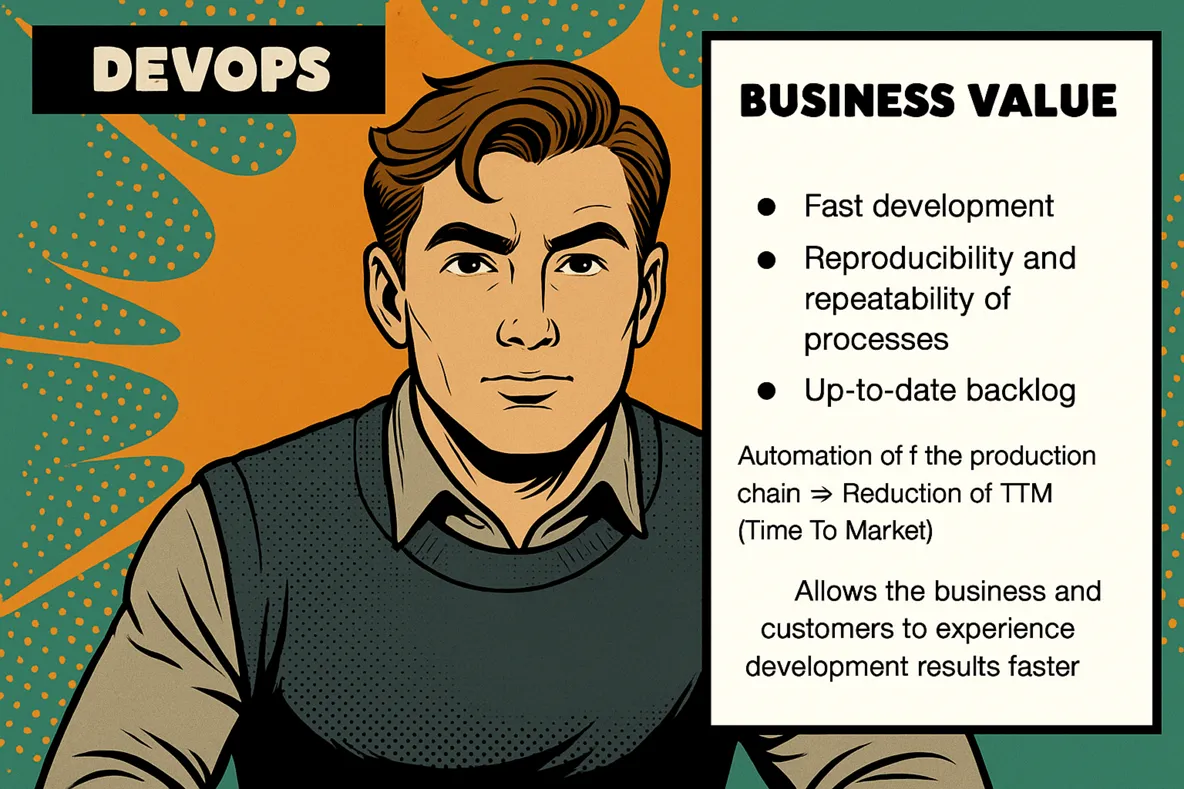
DevOps is a set of cultural norms and technical practices that enable the rapid flow of planned work from development through testing into operations, while preserving world-class reliability, availability, and security.
Business Value: By automating processes, DevOps engineers enable faster development cycles and quicker customer feedback, which saves money and increases competitiveness.
Key Metrics (DORA):
- Deployment Frequency (DF): How often code is successfully released to production.
- Mean Lead Time for Changes (MLT): The time it takes from code commit to production deployment.
- Change Failure Rate (CFR): The percentage of deployments that cause a failure in production.
- Mean Time to Recovery (MTTR): How long it takes to recover from a failure in production.
Site Reliability Engineer (SRE)
SRE focuses on production operations. This includes predicting incidents, improving the release process, conducting post-mortems, and monitoring customer satisfaction. SREs work on the front lines, combining rapid decision-making with swift execution to maximize the availability and reliability of production environments.
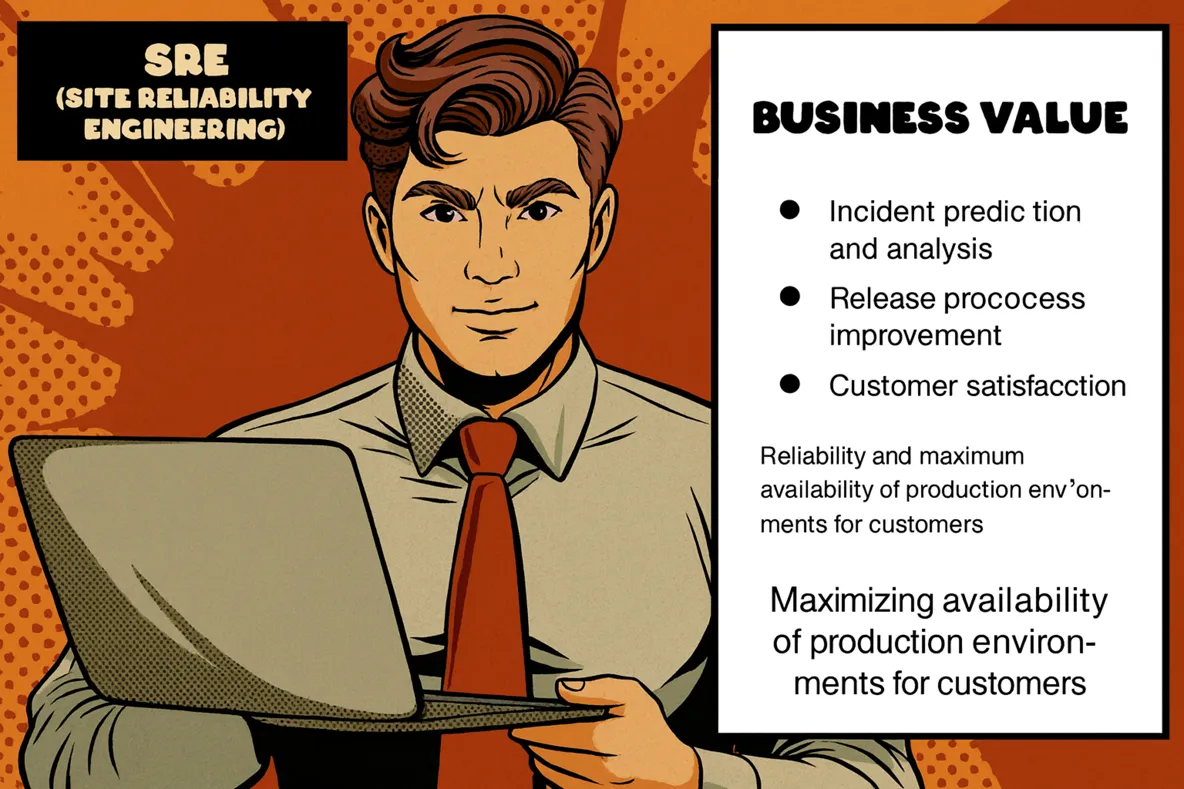
Business Value: SREs directly impact the bottom line. Fewer incidents and higher availability mean more revenue, while greater customer satisfaction leads to a stronger competitive edge.
Key Metrics: SREs also rely on SLAs, SLOs, and SLIs to define and measure the reliability of their services from the user's perspective.
Employee burnout often happens when a role's expectations don't align with the business's incentives. From the company's perspective, this misalignment leads to low engagement and high turnover. The root cause is often a misunderstanding of what each role contributes.
In an ideal world, these roles form a collaborative ladder where the work of one provides the foundation for the next. While they may use the same tools, their purpose is different. A drill doesn't make a jeweler a dentist, and knowing Ansible doesn't turn a DevOps engineer into an SRE.
A specialist is defined not by their tools, but by the business need they fulfill:
- Need a stable infrastructure foundation? Hire a System Administrator.
- Need to optimize your development and delivery pipeline? Hire a DevOps Engineer.
- Need to guarantee production reliability and performance? Hire an SRE.
Trying to hire one person to do all three jobs inevitably leads to burnout and subpar results. By understanding and respecting these distinct roles, the IT community can foster better practices and build more resilient, effective teams.