

Patterns of Microservices Architecture: From Interview to Production
You've likely heard of microservices, a popular architectural pattern in modern software development. This approach structures an application as a collection of loosely coupled services, each responsible for a specific business capability.
This article breaks down the core concepts of microservices, explores their pros and cons, and dives into the essential design patterns you'll need to know to impress interviewers and excel in your next technical discussion.
What Are Microservices?
A microservice architecture breaks a large application into smaller, independent services. Because each service is self-contained, a team can update, deploy, and scale it without affecting the rest of the application. This autonomy is a cornerstone of the microservices approach.
Ideally, a small, dedicated team manages each service, which simplifies development and communication compared to navigating a large monolith. While this is common in large organizations, a single team might oversee all services in smaller projects.
Key Advantages
- Fault Isolation: An issue in one service doesn't bring down the entire application. Other services can continue to function, enhancing overall system resilience.
- Independent Scaling: Services can be scaled individually based on their specific resource needs, leading to more efficient infrastructure usage.
- Technology Flexibility: Teams can choose the best technology stack for each service, allowing for a mix of languages, databases, and frameworks.
- Data Isolation: Each service manages its own database, simplifying schema updates as changes only affect a single service's domain.
Potential Drawbacks
- Complexity: While individual services are simple, orchestrating, managing, and monitoring a distributed system is significantly more complex than a monolith.
- Testing: End-to-end testing becomes more difficult due to the intricate dependencies and interactions between multiple services.
- Data Consistency: Maintaining data consistency across multiple databases requires complex patterns like Sagas or event-driven approaches.
- Network Latency: Communication between services over a network introduces latency, which can impact performance, especially in long chains of API calls.
- Versioning: Updating a service can break dependent services. A robust API versioning strategy is crucial to ensure backward compatibility.
Essential Patterns for Your Next Interview
Interview questions about microservices test not just your theoretical knowledge but also your ability to apply these concepts in real-world scenarios. Let's dive into the key patterns you'll likely be asked about.
API Gateway
The API Gateway is a central entry point for all client requests, acting as a reverse proxy to route traffic to the appropriate backend microservices. It sits at the edge of the system, simplifying client interactions and handling cross-cutting concerns.
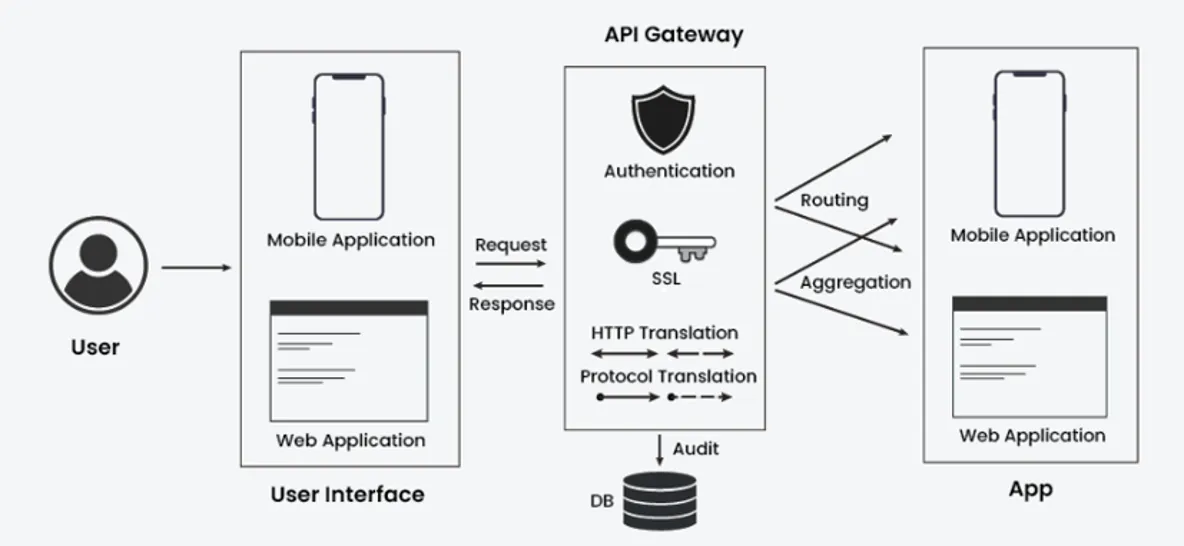
- Routing and Load Balancing: The gateway directs requests based on predefined rules and distributes traffic across multiple service instances to ensure high availability.
- Protocol Translation: It can convert external client protocols (e.g., HTTP) into different internal protocols (e.g., gRPC) used for service-to-service communication.
- API Aggregation: The gateway can combine results from several microservices into a single, unified response, simplifying the client-side logic.
- Gateway Offloading: It handles common tasks like authentication, authorization, rate limiting, and caching, so individual microservices don't have to.
Service Discovery
In a dynamic environment where service instances are constantly created and destroyed, services need a way to find each other. Service Discovery automates this process by maintaining a central registry of available service instances and their network locations.
There are two main approaches:
- Client-Side Discovery: The client service queries the service registry to get a list of available instances and then uses a load-balancing algorithm to select one and make a request directly.
- Server-Side Discovery: The client makes a request to a router or load balancer, which then queries the service registry and forwards the request to an available service instance. This abstracts the discovery logic away from the client.
Circuit Breaker
The Circuit Breaker pattern prevents an application from repeatedly trying to call a service that is down or struggling. By wrapping service calls in a circuit breaker object, it monitors for failures and can temporarily halt requests, giving the failing service time to recover and preventing cascading failures.
Much like an electrical circuit breaker, this pattern interrupts the flow when something goes wrong. It operates in three states:
- Closed: The normal state. Requests flow freely, and the breaker monitors for failures. If the failure rate exceeds a threshold, it trips and moves to the Open state.
- Open: The breaker immediately rejects all requests, preventing calls to the failing service. After a cooldown period, it transitions to the Half-Open state.
- Half-Open: The breaker allows a limited number of test requests through. If they succeed, it returns to the Closed state. If they fail, it trips back to Open.
Event-Driven Architecture (EDA)
In an Event-Driven Architecture, services communicate asynchronously by producing and consuming events. Instead of making direct requests, a service emits an event (e.g., `OrderPlaced`), and other interested services subscribe and react to it. This decouples services, improves scalability, and enhances resilience.
To further impress your interviewer, mention some common technologies used in EDA:
- Apache Kafka: A distributed event streaming platform for high-throughput, fault-tolerant messaging.
- RabbitMQ: A popular and versatile message broker that supports multiple messaging protocols.
- AWS SNS/SQS: Managed cloud services for building highly scalable, decoupled applications.
Event Sourcing
Instead of storing just the current state of data, Event Sourcing stores the full sequence of state-changing events. The current state is derived by replaying these events. This provides a complete audit log, allows for easy reconstruction of past states, and is a natural fit for event-driven systems, though it can add complexity to querying.
Strangler Fig Pattern
Named after a fig vine that slowly strangles a host tree, this pattern provides a strategy for migrating from a legacy monolith to microservices incrementally. New microservices are built around the monolith, and traffic is gradually rerouted from the old system to the new services until the monolith is eventually phased out. This reduces the risk associated with a big-bang rewrite.
When applying this pattern for the first time, start with a simple, low-risk component, preferably one with good test coverage. Alternatively, target a high-traffic component or one that requires better scalability, as replacing these can deliver the most immediate business value.
Database per Service
This fundamental pattern dictates that each microservice should own and manage its own private database. This ensures loose coupling, as no other service can directly access another's data store. While this improves autonomy and scalability, it introduces challenges in managing distributed transactions and maintaining data consistency, often requiring patterns like Saga or Event-Driven Architecture.
CQRS (Command Query Responsibility Segregation)
CQRS is a pattern that separates read (Query) and write (Command) operations into different models. Commands are responsible for changing state, while Queries are responsible for reading state. This separation allows you to optimize each path independently. For example, you can scale your read models for high performance without impacting the write side.
This pattern is most beneficial in applications with complex business logic where read and write operations have different performance requirements, or in systems handling large, frequently changing datasets.
Preparing for the Interview
- Deepen Your Understanding: Go beyond definitions. For each pattern, be ready to discuss its purpose, benefits, and drawbacks in different real-world contexts.
- Prepare for Practical Questions: Be ready to discuss implementation details. How would you use a Circuit Breaker for fault tolerance? How would you ensure data consistency with the Database per Service pattern?
- Stay Current: Microservice architectures are constantly evolving. Show your interviewer that you follow the latest trends and best practices from resources like suddo.io and other industry blogs.