

How AI Agents Work and Who Really Needs Them
AI agents are dominating headlines, often hailed as the next big revolution set to replace human workers. But beyond the hype, what's their real-world value for businesses today? For leaders and investors, the key is to distinguish between genuine cost-saving tools and expensive experiments.

This article breaks down what AI agents are, where they deliver tangible benefits, and how to determine if your company is ready to pilot this technology.
What Are AI Agents and How Do They Differ from LLMs?
The evolution of large language models (LLMs) can be seen as a series of advancing levels, moving from simple text generation to complex, autonomous action.
- Level 0: The Basic LLM. This model operates solely on its training data, like an encyclopedia with no internet connection—useful, but disconnected from real-time information.
- Level 1: The Tool-Augmented Agent. This agent can connect to external tools like search engines, APIs, and databases to access current information, such as finding new TV series or checking stock prices.
- Level 2: The Strategic Agent. Capable of tackling multi-step problems, this agent excels at contextual engineering. It can identify and package the right data to perform tasks accurately, like extracting flight details from a long email to create a calendar event.
- Level 3: The Multi-Agent System. Instead of one generalist agent, a team of specialists collaborates. For example, a project manager agent might delegate tasks to researcher, designer, and marketer agents to drive a project forward.
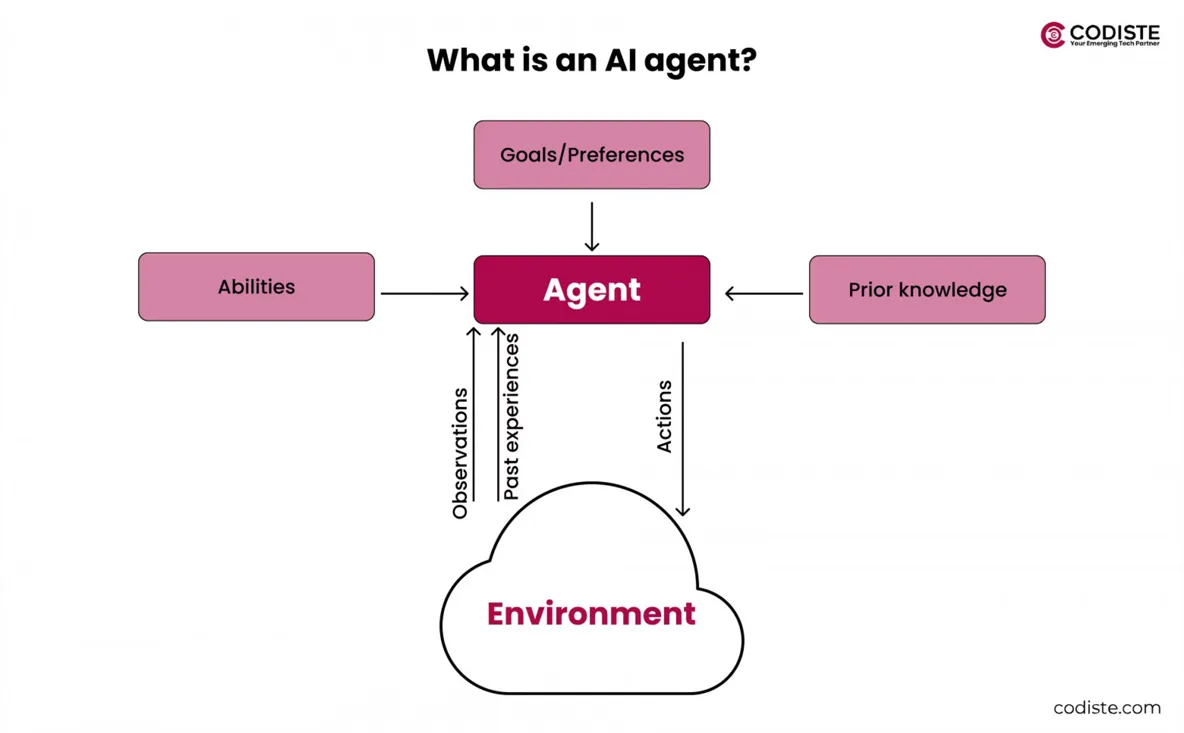
An AI agent is a solution that not only answers questions but also executes actions within a business process, such as creating a support ticket, checking code, or classifying documents.
Think of it this way: you ask a human assistant to organize your schedule. They don't just answer questions; they perform a series of actions:
- Understands the goal.
- Gathers information from emails, calendars, and contacts.
- Creates a plan of action.
- Executes the plan by sending invites and updating calendars.
- Learns from the process to improve future performance.
This action-oriented cycle transforms the agent from a simple respondent into an active executor, capable of handling tasks from start to finish by integrating with your company's systems to automate routine work.
Two Types of AI Agents
Workflow Agents
These agents are embedded within a clearly defined business process. They function like a digital employee who always follows instructions.
- Follow a strict, predefined sequence: input → process → output.
- Handle tasks like routing incoming emails, checking code against a checklist, or filling out forms in an ERP system.
The primary business advantage is reliability. Workflow agents rarely deviate from their script, making them ideal for tasks where error risk is minimal. Their main drawback is inflexibility; if the process changes, the agent must be reconfigured.
Autonomous Agents
These are more advanced agents that are given a goal and determine for themselves how to achieve it. They don't follow a rigid script but instead combine various tools and adapt their process as needed. Developer assistants like Cursor are a prime example.
The business benefit is flexibility. Autonomous agents can be entrusted with a wider range of tasks, including creative and research-oriented ones. However, the cost of error is higher, and their behavior is less predictable, making them more common in R&D than in widespread deployment.
Where AI Agents Are Already Delivering Value
AI agents are not a one-size-fits-all solution. Their value shines brightest in areas with high-volume, routine, and well-defined processes. Here are the key domains where companies are already seeing a significant impact.
HR and Talent Management
- Candidate Screening: Automatically scores resumes and applications to identify the most relevant candidates.
- Interview Summarization: Generates concise summaries from interviewer notes or meeting transcripts.
- Job Description Generation: Creates compelling job postings based on company requirements and market trends.
Business Impact: Reduces the time HR specialists spend on manual tasks, accelerates the hiring cycle, and enables more consistent candidate evaluation.
Document Management and Internal Operations
- Data Extraction: Pulls key information from scans and unstructured documents to populate structured fields.
- Form Processing: Handles the filling of forms in ERP or CRM systems, automating bureaucratic procedures.
- Email Routing: Automatically directs incoming inquiries to the appropriate departments.
Business Impact: Lowers employee workload, reduces data entry errors, and speeds up approval processes.
Software Development
- Automated Code Review: Triggers on a merge request to provide feedback on style, security, and coding standards.
- Automated Patching: After classifying a bug, the agent can suggest or even write the necessary code fix.
- Full Lifecycle Support: Assists with the entire Product Development Life Cycle (PDLC), from bug analysis to release preparation.
Business Impact: Significantly cuts down on routine developer tasks, improves code quality, and reduces testing costs.
The takeaway is clear: agents excel where they can perform numerous, repetitive operations according to well-defined rules.
Case Study: Accelerating a Real Estate Developer's Operations
FSK, a major real estate developer, faced a common challenge: their support and sales teams were spending too much time answering repetitive questions, while internal staff struggled to find information in dense corporate documents. The red_mad_robot team helped FSK streamline these processes with a smart platform powered by two AI agents.
The Two-Agent Solution
The first agent handles frequently asked questions, offloading work from the support team to assist partners and clients. The second agent serves internal employees by quickly locating information within the company's vast document repository. These agents don't follow a rigid script; they analyze the context of each query to determine the best way to find and formulate an answer.
Overcoming AI Hallucinations with RAG
A critical challenge was eliminating AI "hallucinations"—instances where the model invents information. To prevent this, the team implemented a Retrieval-Augmented Generation (RAG) approach, ensuring the AI bases its answers exclusively on verified company documents. The system ingested FSK's entire knowledge base and organized it into a searchable graph, allowing the agents to retrieve factual data before formulating a response.
The Results
The results were substantial. Within two months, the workload on the support and sales departments decreased by 30-40%. Partners now receive faster, more accurate answers, and employees save valuable time on document retrieval. This case demonstrates that modern AI agents can automate entire processes, serving as powerful tools that directly boost operational speed and quality.
When to Postpone Implementing an AI Agent
1. You Can't Automate Chaos
An agent can't create order from scratch. If your processes are not formalized and employees follow inconsistent workflows, implementing an agent will only solidify the chaos.
2. The Cost of Error is Too High
In some processes, an agent's mistake can be critical. Agents are best suited for tasks where a certain tolerance for error is acceptable and a human is available for final validation.
3. The Illusion of Savings
Saving an employee five minutes doesn't always translate into a meaningful business impact. Real value emerges when an agent saves hours of team-wide effort or significantly reduces the workload of an entire department.
4. Lack of Organizational Maturity
A successful implementation requires well-documented processes, a clear IT infrastructure, and accessible systems. If a company's IT landscape is fragmented or relies on legacy systems, integration can consume more time and resources than the agent development itself.
The Economics of AI Agents: Calculating ROI
How to Measure Impact
A common mistake is to measure impact in minutes saved, which rarely reflects true cost savings. A much better approach is to measure:
- Reduced FTE (Full-Time Equivalent): When an agent truly replaces the work of one or more employees.
- Process Acceleration: When a core process, like request handling, is significantly faster, allowing more volume without expanding the team.
- Error Reduction: Leading to fewer penalties, less rework, and higher quality outcomes.
Payback Period and Scaling
For most projects, the ROI is not immediate. The typical payback period is 6 to 18 months. The real gains come from scaling; automating one process often creates opportunities to automate adjacent ones, creating a system of agents where savings grow non-linearly.
In summary, calculate the economics of AI agents in terms of replaced roles, accelerated processes, and improved quality. This is a long-term strategy, not a quick win.
Checklist: Is Your Company Ready for an AI Agent Pilot?
- You have a suitable process. It's repetitive, well-defined, and currently consumes significant employee time.
- Success metrics are defined. For example: reduce processing time by 30%, lower workload by 2 FTE, or decrease errors by 50%.
- Data and integrations are ready. You know where the necessary data resides and have access to the required systems.
- A test sample is collected. A baseline of 100–200 real-world examples is prepared to benchmark the agent's performance.
- A human-in-the-loop is assigned. An employee is ready to review the agent's output during the pilot phase to minimize risks.
- The pilot is scoped. The initial launch is limited to a specific process or department to compare 'before' and 'after' results.
- Go/No-Go criteria are established. You have predefined what constitutes success and what would be a reason to halt the project.
Conclusion
AI agents are powerful automation tools that are already delivering real business value. However, their success hinges on applying them to mature processes where the potential benefits are clear. Launching an agent for the sake of technology alone is a recipe for wasted time and resources.
The key takeaway for business leaders is simple: start small, meticulously calculate the economics, and scale gradually. An initial pilot can demonstrate value within months, but a fully integrated system of agents can fundamentally elevate your company's efficiency for the long term.